
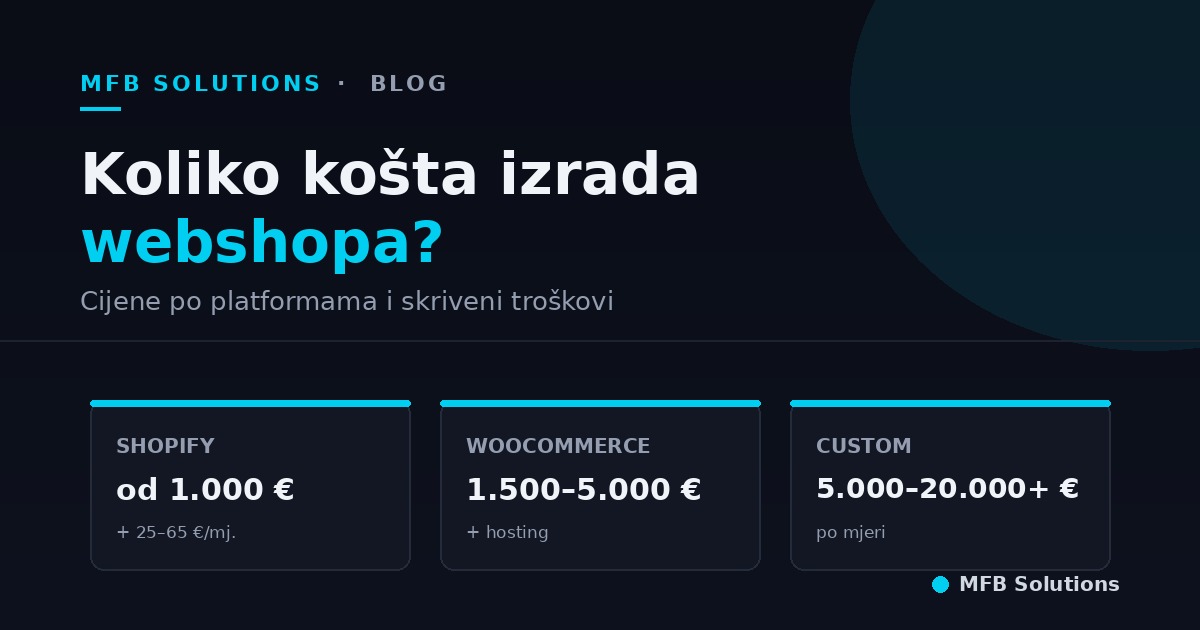
Here’s the quick answer: building an online store in 2026 starts at roughly €1,000 for a simple Shopify setup, runs €1,500–5,000 for a WooCommerce store, and reaches €5,000–20,000+ for a fully custom build. But the setup fee is only part of the picture. The real cost of an online store includes monthly subscriptions, payment processing fees, delivery, and ongoing maintenance, which together often outweigh the initial build over a year.
Below we break down pricing by platform and cover the costs that rarely show up in a quote until the first invoice arrives.
How much does an online store cost by platform?
Shopify: fast to launch, monthly subscription
Shopify is a SaaS platform: you don’t pay for a build “from scratch”. Instead, you pay a monthly subscription to use the system, and setup (design, theme customisation, product uploads) is billed separately.
- Setup: from €1,000 for a smaller catalogue with a customised theme
- Monthly subscription: roughly €25–65/month depending on plan
- Upside: fast launch, security and updates are handled by Shopify
- Downside: limited customisation without paid apps
WooCommerce: flexibility on WordPress
WooCommerce is a WordPress plugin and the most common choice for mid-sized merchants who want their own hosting and full control.
- Setup: €1,500–5,000 depending on catalogue size, design, and add-ons
- Hosting: €10–40/month for WooCommerce-optimised hosting
- Upside: high flexibility, thousands of plugins, you own your data
- Downside: you (or your developer) are responsible for security and updates
Custom-built store: full control
For merchants with specific requirements (a large catalogue, unusual integrations, a distinctive customer journey), a fully custom build without an off-the-shelf platform offers the most control, at the highest price.
- Cost: €5,000–20,000+, depending on catalogue complexity and integrations
- Upside: complete customisation, no platform limitations, faster load times
- Downside: longer build time and higher upfront investment
What costs usually stay hidden?
A build quote rarely covers everything you’ll face after launch. These are the ones that catch owners off guard most often:
1. Payment processing fees
Every card transaction carries a fee, typically 1.5% to 3% of the order value, depending on the payment processor. At higher sales volume, this line item turns into a serious monthly cost, and many owners never budget for it upfront.
2. Delivery and packaging
Delivery isn’t just courier cost. There’s packaging, occasional returns, and the time someone spends preparing parcels. If you plan to offer free shipping above a threshold, that cost belongs in your product margin, not in the store’s build budget.
3. Monthly maintenance and security
An online store isn’t a “finished project” after launch. Regular updates (especially on WooCommerce), security patches, monitoring, and periodic catalogue changes need ongoing attention. A realistic range for regular maintenance is €50–200/month, depending on store size.
4. Apps and add-ons
On Shopify, many useful features (advanced analytics, marketing automation, additional languages) come as paid apps with their own monthly fee. WooCommerce has a similar dynamic with premium plugins. These costs can add up to another €20–100/month.
5. Content and product photography
Quality photos and product descriptions aren’t included in most build quotes. If you have a hundred-plus items, photography and copywriting can end up costing more than the technical build itself.
6. Fiscalisation and bookkeeping (Croatia-specific)
In Croatia, every sale made through an online store must go through fiscalisation, just like sales in a physical shop. That means you need a fiscal cash register or a software solution connected to your payment system, plus proper bookkeeping to track revenue and VAT. If you already run a registered business with fiscalisation in place, connecting it to your store is usually a one-time integration cost; if you’re just starting to sell, this is a line item to budget for before launch, not after your first order.
How to keep the total cost down without cutting quality
- Start with a smaller catalogue and expand gradually, because it’s easier to test demand with 20 products than to launch 500 at once.
- Choose the platform based on volume, not trends. Shopify suits a fast start, WooCommerce suits more control, and a custom build only makes sense once volume justifies it.
- Negotiate a fixed price for a clearly defined scope, not an open-ended hourly rate.
- Check the payment processor’s fee before signing anything. A half-percent difference on high volume adds up to hundreds of euros a year.
- Plan for maintenance upfront, rather than discovering it as a surprise three months after launch.
For a deeper look at whether you actually need an online store versus a presentation website, see does your business need an online store. You can review indicative packages and pricing on our web development services page, or get a tailored recommendation through our short questionnaire.
Frequently asked questions
Is Shopify cheaper than WooCommerce? In the short term, yes. There’s no hosting or security-update cost since Shopify handles that. Over the long term, at higher sales volume, the monthly subscription and paid apps can make WooCommerce more cost-effective.
How much should I realistically budget per month for a small store? Including subscription or hosting, a paid payment system, and basic maintenance, a realistic range for a small store is €80–250/month, excluding transaction fees.
Is there a free way to build an online store? Free tools and trial periods exist, but a professional look, security, and customer support almost always require investment, whether in a subscription or in the build itself.
How long does it take to build an online store? A smaller Shopify or WooCommerce store realistically takes 3–6 weeks, depending on the number of products and integrations. Custom builds take longer, depending on scope.
Do I need a lawyer for my store’s terms of sale? It’s worth having a lawyer at least review your terms of sale and returns policy template, since the legal obligations for an online store differ from those of a standard presentation website.
Not sure which platform and scope fit your product and budget? Fill out our short questionnaire and we’ll recommend an approach tailored to your situation, no obligation.