
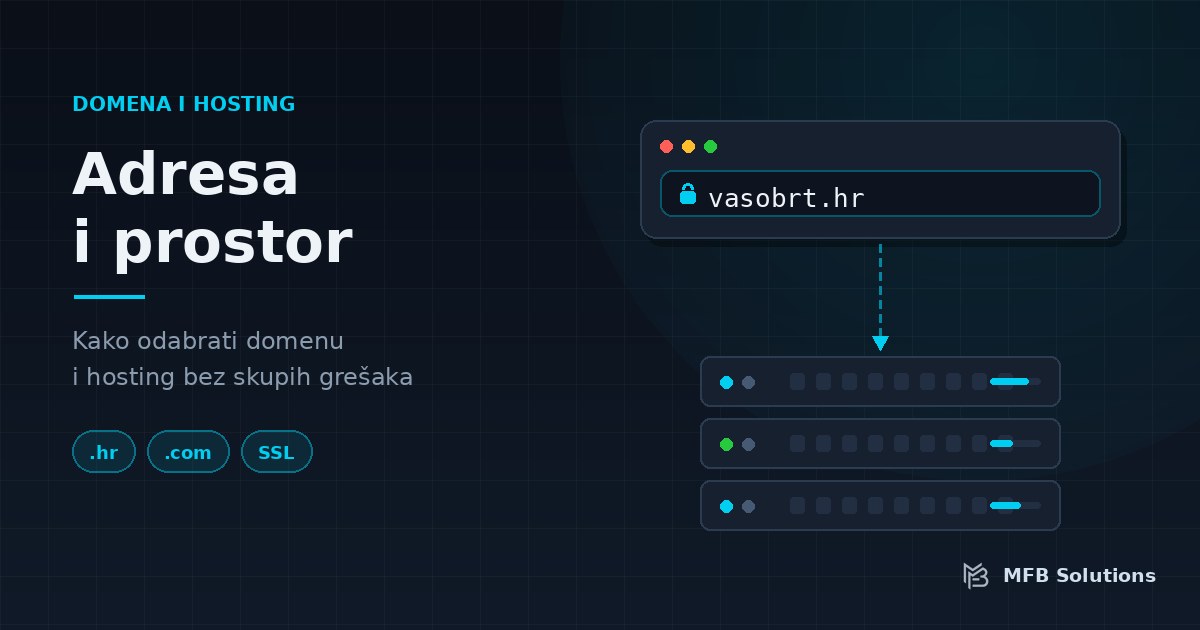
If you need the short answer: a domain is your website’s address, hosting is the space your website lives in, and they are two separate services you don’t have to buy from the same provider. For a small business, a domain realistically costs somewhere between €10 and €80 a year depending on the extension and registrar, and solid hosting between €3 and €15 a month. The most important rule isn’t price, though. It’s ownership. The domain must be registered to you, with the login details in your hands.
Below we cover the difference between the two, how to pick a name and extension, which type of hosting you actually need, and the traps that cost money later.
What’s the difference between a domain and hosting?
The simplest comparison is a business premises. The domain is the address: yourbusiness.com. Hosting is the space itself: the server holding your files, images, and content. An address with no space behind it leads nowhere, and a space with no address can’t be found.
You buy these two things separately, even though most providers sell them bundled. A bundle is convenient because everything sits on one invoice, but it has a downside: if you later want to switch hosting while your domain is tied to the same provider, the move gets a little more tangled. That’s why many people keep the domain with one registrar and hosting with another. Starting out with a bundle isn’t wrong. Just know it isn’t mandatory.
The third piece of the puzzle is DNS records. That’s the set of instructions telling the internet which server your domain points to. When you change hosting, you’re really changing those records, not the domain.
Which domain extension should you choose?
The answer depends on who your customers are.
If you work with a single local market (a trade business, a local service, a shop that delivers within one country), a country extension like .hr is the natural choice. It reads as more serious to local visitors and makes it clear where you are. For local searches, it’s a small but useful trust signal.
If you’re targeting customers abroad or planning to grow beyond your region, .com is universal and boxes nobody in. Plenty of companies buy both versions and redirect one to the other, which also stops someone else from grabbing their name.
On price, be realistic, because it varies a lot. A .com domain typically costs around €10 to €20 a year. Country extensions differ by registry: in Croatia, for example, registered businesses are generally entitled to one free .hr domain matching their company name, while additional paid ones run roughly €15 to €80 a year depending on the registrar. Because each registrar sets its own retail price, it’s worth comparing a few offers before you register.
How much does the extension matter to Google?
Less than people think. The extension alone won’t rank you better. A country extension helps Google understand which market you’re targeting, which is useful for local queries, but content, speed, and links carry far more weight. Don’t delay building your site because you can’t decide between two extensions.
How do you pick a good domain name?
A domain name is one of the few decisions that’s hard to change later, so it’s worth an hour of thought.
A good name is short, easy to say out loud, and memorable on first hearing. If you have to spell your domain out over the phone, it’s too long or too complicated. Avoid hyphens and numbers, because they create confusion when the name is spoken. If your language uses accented characters, register the plain version, because that’s how people type it anyway.
Your business name is usually the best choice, even if it doesn’t describe what you do. A keyword domain like best-plumber-london.com no longer gives you an advantage on Google, and over time it can lock you into one service or one city.
Before you commit, check whether the name is free on social platforms and whether a trademark already exists under it. Consistency across channels makes marketing and recognition easier down the line.
Shared, VPS, or cloud hosting: what do you actually need?
For the vast majority of small businesses the answer is: the simplest option that handles your traffic. Overpaying for capacity you never use is pure waste.
Shared hosting means your site shares a server with many others. Prices run roughly €3 to €10 a month. For a brochure site with a few hundred visits a day, that’s plenty. The limitation is that traffic from neighbouring sites on the same server can slow yours down.
VPS or cloud hosting gives you dedicated resources and runs roughly €10 to €50 a month. It makes sense for online stores, high-traffic sites, or applications with specific requirements. For a simple business card site it’s an unnecessary cost and extra maintenance to worry about.
Managed hosting for a specific platform (specialised WordPress hosting, for instance) costs a bit more but includes updates, backups, and support that actually knows the platform. If you have nobody technical around you, that price difference often pays for itself.
Do you even need hosting?
If your site is static (a brochure site, a portfolio, a landing page with no user accounts), modern static hosting platforms like Cloudflare Pages or Netlify will serve it fast and, at small traffic volumes, free. The site is delivered from a network of servers around the world, so it loads very quickly, and there’s no database to maintain or update. That’s how we build most projects; you can read how it works in practice on our web development page.
What should you check before deciding?
A handful of details separate a good arrangement from one that annoys you for years.
Renewal price. The first year is often discounted and the second can be twice as much. Always check the standard price, not the promotional one.
Backups. Check whether the provider runs them automatically, how long they’re kept, and whether restoring costs extra. A backup that exists but is billed on every restore isn’t real protection.
SSL certificate. It has to be included and free these days. If someone charges for it separately, that’s a sign of an outdated offer.
Server location. If your visitors are in one region, a server on the same continent reduces latency. With static sites on a global network this matters less, since content is served from the nearest point anyway.
Support. Check the hours and language of support before you need it. When the site goes down on a Friday evening, that’s too late to find out.
Portability. The provider must let you export your data and transfer the domain without obstacles. If that isn’t clearly stated, be careful.
What are the most common beginner mistakes?
The costliest mistake is registering the domain in someone else’s name. It happens when a developer or an acquaintance “sorts everything out” for you, and a few years later they’re unreachable, or the relationship has soured. Your domain is a business asset and it has to be in your name.
The second common mistake is a forgotten renewal. The domain expires, the site vanishes, and in the worse scenario someone else picks up the name. Turn on auto-renewal and keep a valid email address in your registrar contact details.
The third is choosing hosting on price alone. A few euros a month feels like a saving right up until the site becomes slow or unavailable. You can compare realistic annual costs and savings by package on our pricing page.
What does a sensible starting setup look like?
For a typical small business just getting going: your company name as the domain, a country extension if you serve one market, shared or static hosting, SSL and automatic backups included, and the domain registered to the owner with auto-renewal on. All in, that usually lands between €60 and €200 a year.
That’s enough to keep a site running for years without drama. When traffic grows or you add a shop, upgrading is straightforward, and if the domain was in your name from day one, migrating is an afternoon’s work rather than a negotiation.
Not sure which parts of this you actually need? Fill in the short questionnaire and we’ll come back with a concrete recommendation for your domain, hosting, and site scope.